
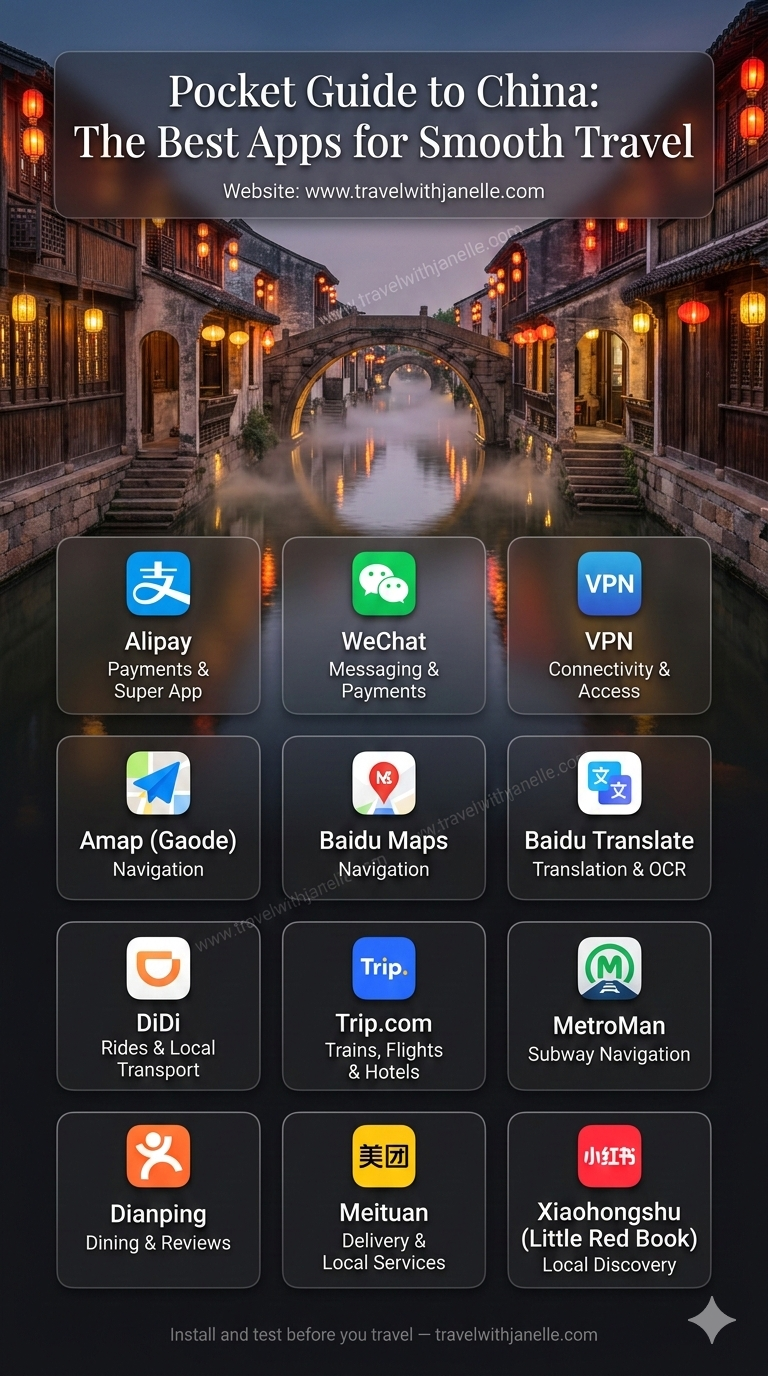
 Navigating China in 2026 is an incredible experience, but it requires a different digital toolkit than the rest of the world. Because of the “Great Firewall” and a unique mobile-first economy, the apps you rely on at home—like Google Maps, Uber, or Instagram—likely won’t work or will be highly inaccurate once you land.
To move through China with ease, you need a curated “pocket guide” of local heavyweights. From hailing a car in Shanghai to translating a menu in a Sichuan village, these 12 apps are essential for any modern traveler.
💳 Payments & Social Essentials
In China, your phone is your wallet. These two apps are non-negotiable.
Alipay
- Why: The most traveler-friendly payment app. It is widely accepted for in-person payments, scanning QR menus, and is the primary way to pay for DiDi rides.
- Setup Tip: Link an international credit card before you arrive. Enable facial ID or a 6-digit passcode for fast, secure transactions at checkout.
- Why: More than just an app; it’s an ecosystem. Use it for messaging local contacts, scanning restaurant QRs, and even checking into some boutique hotels.
- Setup Tip: Register with your international number. Add 1–2 emergency contacts immediately to help with account recovery if you get locked out.
🌐 Connectivity & Access
Staying connected to the global internet requires one specific tool.
VPN (Virtual Private Network)
- Why: Essential for accessing Google services, Gmail, Instagram, and Western news sites, which are otherwise blocked.
- Setup Tip: Buy a reputable paid VPN (free ones rarely work). Install and test it on all devices before you cross the border. Enable “auto-reconnect” so you never lose your encrypted tunnel.
🗺️ Navigation & Translation
Google Maps is often blocked from reality in China. Use these instead.
Amap (Gaode) / Baidu Maps
- Why: These are the “Gold Standard” for accuracy in China, providing real-time data for walking, driving, and public transit.
- Setup Tip: Download offline maps for your destination cities. While the UI is in Chinese, you can copy/paste English addresses from Trip.com to get accurate pins.
Baidu Translate
- Why: Offers superior local vocabulary and a powerful camera OCR (Optical Character Recognition) feature for translating physical signs and menus.
- Setup Tip: Download the English-Chinese offline language pack so you can translate even when your signal is weak.
Apple Maps (Backup)
- Why: A surprisingly reliable secondary option that often works better for English speakers in major Tier-1 cities like Beijing or Shenzhen.
- Setup Tip: Keep it updated as a backup and use it to cross-verify routes if you find the local Chinese apps confusing.
🚗 Transport & Logistics
Getting from Point A to Point B is effortless if you have these installed.
DiDi
- Why: The “Uber of China.” It allows you to hail taxis, private cars, or even pooled rides across almost every city.
- Setup Tip: Link your DiDi account directly to Alipay. This allows for “automatic payment,” so you can simply step out of the car when you arrive at your destination.
MetroMan
- Why: The ultimate tool for subway navigation. It provides transfer planning and exit information for every major Chinese city.
- Setup Tip: Download the specific map for the cities on your itinerary so you can plan your route while underground without Wi-Fi.
🍱 Dining & Discovery
Find the hidden gems that tourists usually miss.
Dianping
- Why: The Chinese equivalent of Yelp or TripAdvisor. It features millions of local reviews, photos of menus, and operating hours.
- Setup Tip: Look for high ratings and recent photos to ensure a restaurant is still in business. Use it to find “hidden gem” cafes in historic alleys.
Meituan
- Why: Essential for food delivery or booking local services. Perfect for those nights when you’re too tired to leave the hotel.
- Setup Tip: Have your hotel address written in Chinese characters ready to copy-paste into the delivery field.
Xiaohongshu (Little Red Book)
- Why: A visual discovery app (like a mix of Instagram and Pinterest). It’s the best place to find trendy spots, “Instagrammable” views, and local travel tips.
- Setup Tip: Search by city tags (e.g., https://www.google.com/search?q=%23Chengdu or https://www.google.com/search?q=%23Shanghai) and save posts to your “Favorites” to show to taxi drivers or guides.
🏨 The Master Key for Bookings
Trip.com
- Why: This is the single most important booking tool for foreigners. It offers a flawless English interface for high-speed trains, domestic flights, and hotels.
- Setup Tip: Add your passport information to your profile ahead of time. This ensures that when you book a train, your “e-ticket” is instantly tied to your passport for seamless boarding.
Planning Your Trip to China?
Now that your digital toolkit is ready, the next step is securing your accommodations and transport. For international travelers, Trip.com is the most reliable platform. It supports foreign credit cards, provides 24/7 English support, and offers instant e-tickets that save you hours of standing in line at stations.
Book Hotels & Trains on Trip.com
- ✔ English-language support
- ✔ Visa and Mastercard accepted
- ✔ Instant train e-tickets
- ✔ 24/7 customer service
This link can be used for any Trip.com booking, including hotels, trains, flights, and attractions. Using it helps support the creation of these free travel guides!